The
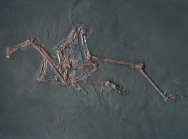
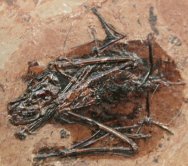
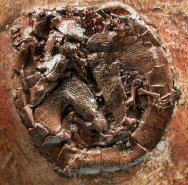
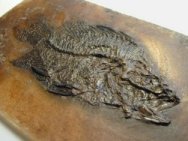
Middle Eocene (50 million year old) oil shales of Messel near Frankfurt, Germany
are world-reknowned for the unusually complete and detailed picture they present
of life of the past. The Laggerstatten site has been called the most important
in the world for understanding the living environment of the Eocene, between 57
million and 36 million years ago. The abundant remains of both animals and plants
represent essentially a complete ecosystem in an exceptional state of preservation.
Not only are the skeletons and other hard parts preserved, but the soft tissues
and even stomach contents that are usually lost can be often seen. The fantastic
exhibit of Messel fossils at the Senckenberg Museum in Frankfurt can leave an
indelible impression on the fossil colletor. There are 50 million year old beetles
with their original metallic green colors, any number of fish and turtles in a
remarkable state of preservation, as well as the early horse Propaleotherium complete
with stomach contents which clearly show which individual species of plants this
early horse ate.
The
Messel area climate was dramatically different from that of
modern-day Germany as shown by the anteaters, tapirs, crocodiles
and many other animal species that have been found. Palm fronds
also point to the climate as having been tropical to sub-tropical
in nature. The Messel Formation consists at its base of gravel
and sand, followed by a flaky claystone
referred
to as "oil shale", and topped by sands and clays.
These are lacustrine (lake) deposits which at the time of deposition
were packed tightly together. Pores filled with water made up
a large part of the volume. Over time, the sheer weight of deposits
from above compressed the materials until solid rock was formed.
Even today Messel rock has a water content of 40%. The high
organic content of the shale can be traced back to the cell
walls of the green alga Tretraedon. They grew in large numbers
in annual blooms, died off, and sank to the bottom mud. The
fineness of the layers indicates that a fairly deep lake was
present at the site. It is the presence of this oil shale deposit
to which we owe the discovery of this magnificent site. Chance
finds of limonite in the area in 1859 led to the mining of "brown
coal" (oil shale) in 1875 and the discovery of the first
fossil (a crocodile) late that year. Under normal circumstances,
fossils are found during the splitting of the shale. Due to
the high water content of the rock, it is very fragile, and
care must be taken to keep the specimens moist during removal.
Because of this fagility, the best method for preservation is
the transfer process: Half the fossil is freed from the shale
using needles and scrapers. A frame of clay is placed around
the specimen, which is then dried briefly with a blast of air.
A thin layer of resin is applied, then dried. Further resin
is then added in thin layers. Once the block has hardened it
can be inverted, and the process repeated on the other side.
The surface of the fossil is then coated with a colorless layer
to stabilize it. The end result is a specimen essentially free
of matrix in a resin support.