Fossils of the Solnhofen Limestone - A Jurassic
Konservat Lagerstätte
in Germany
 The
Solnhofen Limestone ranks as one of the most most famous Lagerstatte
in the world. This fossil site in the state of Bavaria in Germany
has yielded an amazing diversity of fossil organisms, often
deposits known for the exceptional preservation of fossilized
organisms, where the soft parts are often preserved (a Konservat-Lagerstätte),
provides a snapshot of Jurassic life
155 million years ago. The most famous are the eight fossils
of the first bird known in detail, Archaeopteryx.
The first Archaeopteryx fossil was discovered in 1860, a single
feather. The next year a very complete example was found and
sold to the British Museum. The next specimen was discovered
sixteen years later, and is known as the Berlin specimen. It
is considered by some to be the most valuable fossil in the
world today. With its combination of characteristics of reptile-like
teeth and tail with the feathers of a bird, it was a quintessential
missing link that supporters of Charles Darwin could refer
to as proof of the theory of evolution. In the subsequent
140 plus
years since the first bird was found, only six more have been
added to the handfull of examples.
The
Solnhofen Limestone ranks as one of the most most famous Lagerstatte
in the world. This fossil site in the state of Bavaria in Germany
has yielded an amazing diversity of fossil organisms, often
deposits known for the exceptional preservation of fossilized
organisms, where the soft parts are often preserved (a Konservat-Lagerstätte),
provides a snapshot of Jurassic life
155 million years ago. The most famous are the eight fossils
of the first bird known in detail, Archaeopteryx.
The first Archaeopteryx fossil was discovered in 1860, a single
feather. The next year a very complete example was found and
sold to the British Museum. The next specimen was discovered
sixteen years later, and is known as the Berlin specimen. It
is considered by some to be the most valuable fossil in the
world today. With its combination of characteristics of reptile-like
teeth and tail with the feathers of a bird, it was a quintessential
missing link that supporters of Charles Darwin could refer
to as proof of the theory of evolution. In the subsequent
140 plus
years since the first bird was found, only six more have been
added to the handfull of examples.
The
discovery of the wonderful fossils
of Solnhofen may be attributed
to the longtime uses to which the "plattenkalk" has
been used. This is a German word that seems more appropriate
than the English "platy limestone". Plattenkalk was
used as early as the Stone Age for making drawings and colored
murals due to its softness. The flat, regularly shaped material
was suitable for paving roads and building walls, something
done by the ancient Romans  who
for a time held sway over the region. In the Middle Ages, the
stone was used as floor and roofing material. The mosaic floor
of the church of Hagia Sofia in Istanbul was made of limestone
from the region. Artisans also used the material in the making
of bas-relief sculptures and headstones. A decisive turning
point in the history of the area was the discovery in 1673 by
Alois Senefelder that the fine-grained material could be employed
in lithography, a use that caused quarrying to skyrocket. Although
the heyday of lithography only lasted a hundred years or so,
it was the single most important impetus in the discovery of
fossils.
who
for a time held sway over the region. In the Middle Ages, the
stone was used as floor and roofing material. The mosaic floor
of the church of Hagia Sofia in Istanbul was made of limestone
from the region. Artisans also used the material in the making
of bas-relief sculptures and headstones. A decisive turning
point in the history of the area was the discovery in 1673 by
Alois Senefelder that the fine-grained material could be employed
in lithography, a use that caused quarrying to skyrocket. Although
the heyday of lithography only lasted a hundred years or so,
it was the single most important impetus in the discovery of
fossils.
The
fossils have always been prized by local residents because of
their beauty. As those most intimately associated with the limestone, the quarrymen were obviously those who were
responsible for their discovery. At first, quarry owners allowed
the workers to keep the fossils they found, but as interest
in them (and consequently, value) grew, this practice stopped.
The variety and number of fossils known is deceptive. The occurrence
of fossils is quite low. Indeed, a worker can quarry for an
entire day and find not a single one. The hundreds of years
of quarrying are what make them seem so apparently common.
with the limestone, the quarrymen were obviously those who were
responsible for their discovery. At first, quarry owners allowed
the workers to keep the fossils they found, but as interest
in them (and consequently, value) grew, this practice stopped.
The variety and number of fossils known is deceptive. The occurrence
of fossils is quite low. Indeed, a worker can quarry for an
entire day and find not a single one. The hundreds of years
of quarrying are what make them seem so apparently common.
The
sheets of limestone are so regular that we can only conclude
that they were deposited in a calm environment. The deposits
were evidently laid down under a stable body of water that had
some connection to the Tethys Sea. Sponges and corals grew on
rises in this sea, forming lagoons. In fact, remnants of a coral
reef can be found in the area to the south of Solnhofen. The
region must have been near land, however, due to the discovery
of insects such as wonderfully-preserved dragonflies. Assuming
that Jurassic coral reefs grew in modes similar to those of
today, the surface of the reefs would have been only 10 meters
or so under water. The maximum depth has been estimated by some
to have been 60 meters (200 feet).
 These
isolated lagoons would have been quite stagnant due to little
exchange of water with the sea. Anoxic conditions would have
been ideal for preventing destruction of organisms that found
their way into the lagoons. Some evidently survived for short
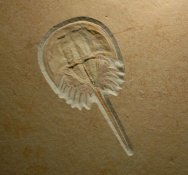
periods. One of the most famous examples of this are the horseshoe
crab "death spirals' that exist in which a spiral trackway
has been preserved with the defunct arthropod in the center,
presumably preserving its last efforts at survival. The theory
most often proposed for the toxicity of the waters has been
that of hypersalinity, the excessive concentration of salt.
If the area were hot and dry, with little runoff from the land
to the north, conditions would have been ideal for promoting
excessive evaporation of water with concomitant increase in
the salinity in the lagoons. The dense brine would collect in
the bottom of the pools, excluding most life, as sensitivity
to even minute changes in density has been seen in many marine
organisms. Once an organism had been washed into the lagoon
by the action of a storm, it would quickly succumb to the toxic
conditions that existed within. The hypersaline, anoxic floor
was ideal for the preservation of the body, often even leaving
evidence of soft tissues.
These
isolated lagoons would have been quite stagnant due to little
exchange of water with the sea. Anoxic conditions would have
been ideal for preventing destruction of organisms that found
their way into the lagoons. Some evidently survived for short
periods. One of the most famous examples of this are the horseshoe
crab "death spirals' that exist in which a spiral trackway
has been preserved with the defunct arthropod in the center,
presumably preserving its last efforts at survival. The theory
most often proposed for the toxicity of the waters has been
that of hypersalinity, the excessive concentration of salt.
If the area were hot and dry, with little runoff from the land
to the north, conditions would have been ideal for promoting
excessive evaporation of water with concomitant increase in
the salinity in the lagoons. The dense brine would collect in
the bottom of the pools, excluding most life, as sensitivity
to even minute changes in density has been seen in many marine
organisms. Once an organism had been washed into the lagoon
by the action of a storm, it would quickly succumb to the toxic
conditions that existed within. The hypersaline, anoxic floor
was ideal for the preservation of the body, often even leaving
evidence of soft tissues.
Storms
would have often brought in a suspension of finely-dispersed
lime. Such storms would have brought in the amazing diversity
of life we know from the region: pterosaurs, dinosaurs like
Compsognathus and Archaeopteryx, dragonflies, and other insects,
fish, turtles, crinoids, starfish, jellyfish, ammonites, worms,
plants, and many, many more. The number of species found exceeds
500. The limestone deposits of Solnhofen open a door closed
to us over 150 million years ago, affording us a look at a wonderful
diversity of life from both the land and the sea of the Jurassic.